
Stainless Steel Jewelry Production: Minimums and Lead Times
Order planning for stainless steel jewelry comes down to two numbers that behave differently: the minimum, which multiplies by design count, and the lead time, which stacks in fixed blocks. TTT Jewelry publishes 100+ pieces per design for stainless, 50 for 925 sterling silver and 100 for artisan eco-brass, with 25–30 days for sampling and 3–4 weeks for bulk production. A first order built on those figures lands in roughly seven to nine weeks after CAD.

Key takeaways
- The MOQ applies per design, so four stainless designs commit 400 units before any reorder.
- Sampling at 25–30 days is the longest single block, and a repeat round doubles it.
- Bulk production of 3–4 weeks equals 21–28 days on the calendar.
- CAD takes under 48 hours, which is 3.3–4.2% of a 48–60 day programme.
The minimum is per design, not per order
Most first-time buyers read a minimum as a floor for the purchase order. In jewelry it is a floor for each design, which changes the arithmetic. Ten designs at the stainless threshold means 1,000 pieces; two designs means 200. The unit count and the design count are separate decisions, and only one of them is visible on an invoice at a glance.
That structure exists because a mould and a sample belong to a design, not to a shipment. The factory has to cut a tool, run a prototype, plate a sample and inspect a production lot for every shape on the order. The minimum stops those fixed tasks being spread across too few units: at 100 pieces the tool has a denominator, at 20 it does not.
The practical implication is to launch narrow. Four designs at a solid quantity will carry a collection further than ten thin ones, because a reorder reuses a tool that already exists and a sample that is already approved. A capsule of four also keeps the sample bench from becoming a queue.
How the three metal minimums compare
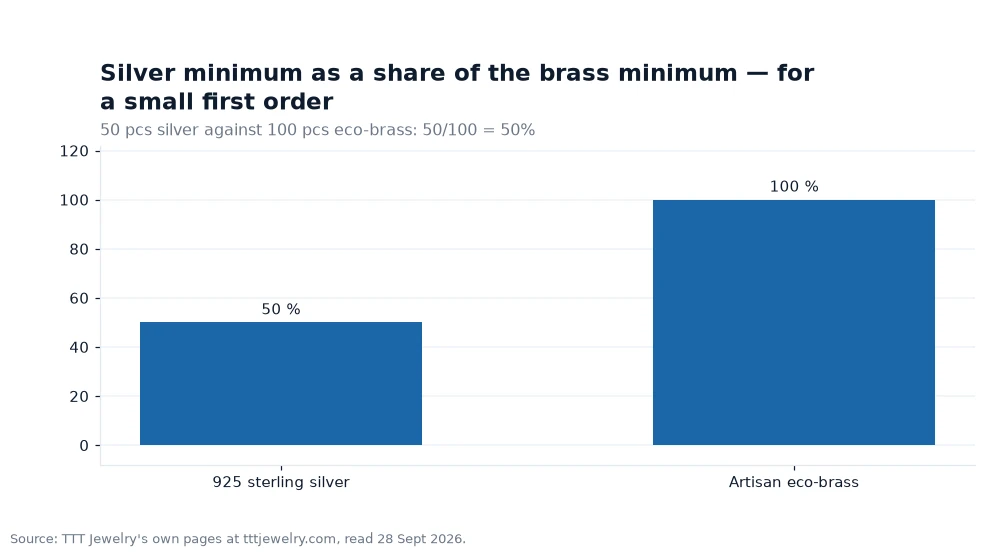
The published thresholds differ by material, and the gap is widest between silver and the other two. Silver starts at 50 pieces per design, brass at 100, stainless at 100+. A collection that spans all three therefore has three different commitment levels for the same number of designs.
| Material | Minimum per design | Commitment at 3 designs | Commitment at 6 designs |
|---|---|---|---|
| 925 sterling silver | 50 pieces | 150 units | 300 units |
| Artisan eco-brass | 100 pieces | 300 units | 600 units |
| Stainless steel | 100+ pieces | 300+ units | 600+ units |
The silver row is the outlier. At 50 per design it is half the brass figure, so a buyer testing a new shape in metal can open it in silver at half the unit commitment and move to brass or stainless once the shape sells. That sequencing uses the minimum structure rather than fighting it, and the silver line's sterling silver jewelry manufacturer page lists the 50-piece threshold with the alloy data.
The stainless row carries a plus sign for a reason. Above 100, quantity is negotiated against the design, the finish and the packing, so the figure should be treated as a threshold to clear rather than a number to land exactly on.
The calendar, stage by stage
Lead time in a custom programme is a stack of blocks rather than a single number. The published flow starts with an inquiry answered within 24 hours, moves to consultation and development, then CAD at under 48 hours, a physical sample in 25–30 days, bulk production in 3–4 weeks, and final QC and delivery with 100% inspection.
Two of those blocks dominate. CAD is 2 days at most. Sampling is 25–30 days, or 3.6–4.3 weeks, and production is 21–28 days. Stacked, the three blocks come to 48 days if both windows close early (2 + 25 + 21) or 60 days if both run long (2 + 30 + 28), which is the seven-to-nine-week window a buyer should put in a launch plan.
Inquiry response sits outside that sum because it happens before the clock starts, but it matters for momentum. A 24-hour reply on a spec question keeps a week from disappearing into email, and a dedicated project manager is the published mechanism for keeping those replies on one thread.
Buyers who want the numbers confirmed against their own design can get a quote with the grade, finish and quantity written out, which produces a schedule rather than a range. A quote built on a picture and a guess tends to be revised at the sample stage.
Where first orders lose time
The blocks are fixed; the gaps between them are not. Most delays on a first order come from three places, and none of them is the factory floor.
The first is an incomplete brief. Stone sizes, wall thickness, clasp type and finish per surface decide whether the first sample is close enough to approve. When one of those is missing, the sample bench fills the gap with an assumption, and the buyer rejects the assumption 25–30 days later.
The second is approval lag. A sample that sits in a review queue for ten days adds ten days to the programme, and no production schedule absorbs that silently. Naming one decision-maker on the buyer side is the least costly scheduling improvement available.
The third is a late packaging decision. Custom packaging is one of the six published options, covering metallic logo tags, foil-stamped boxes, velvet or microfibre pouches, backing cards and barcode labels. Packaging artwork that arrives after production starts holds the order at the packing bench, which is the last place anyone wants a queue.
Worked example
Take a three-design stainless launch. At the 100+ threshold the floor is 3 × 100 = 300 units. Run the same three shapes in artisan eco-brass and the figure is also 3 × 100 = 300; run them in 925 sterling silver and it drops to 3 × 50 = 150, exactly 50% of the stainless commitment.
Now the schedule. CAD at 2 days, sampling at 25–30 days and production at 21–28 days give 48–60 days, or 48/7 = 6.9 weeks to 60/7 = 8.6 weeks. CAD accounts for 2/48 = 4.2% down to 2/60 = 3.3% of that total, so compressing modelling saves days, not weeks.
Add one rejected sample and the block repeats: 48 + 25 = 73 days, or 60 + 30 = 90 days. That is 73/7 = 10.4 weeks to 90/7 = 12.9 weeks, which is why a launch date should be set from the second-round figure rather than the first.
Frequently asked questions
Does the 100-piece minimum apply to each design or to the whole order?
It applies per design, so three stainless designs at the threshold commit 300 units, and the MOQ does not fall because several designs ship together.
How long does a stainless order take from CAD to delivery?
Under 48 hours of CAD, 25–30 days of sampling and 3–4 weeks of production add up to 48–60 days, roughly seven to nine weeks.
Can a first order start in silver and move to stainless later?
Yes. Silver at 50 pieces per design is half the stainless commitment, so a shape can be tested in 925 sterling silver before a 100+ piece stainless run is opened.
Planning the first order backwards from launch
A launch date is easier to hit when it is built from the end of the calendar rather than the start. Take the delivery week, subtract production at 21–28 days, subtract sampling at 25–30 days, then subtract the 2-day CAD window. What remains is the real deadline for decisions.
Buyers comparing materials at that stage can read the TTT Jewelry overview, which sets out the six-step flow and the material minimums on one page. It is a useful cross-check against any schedule drawn up in a spreadsheet, because the published order of operations is what the calendar is built from.
Source note: figures come from the manufacturer's own website (tttjewelry.com), read 28 Sept 2026.[1]